
 Back to Homepage
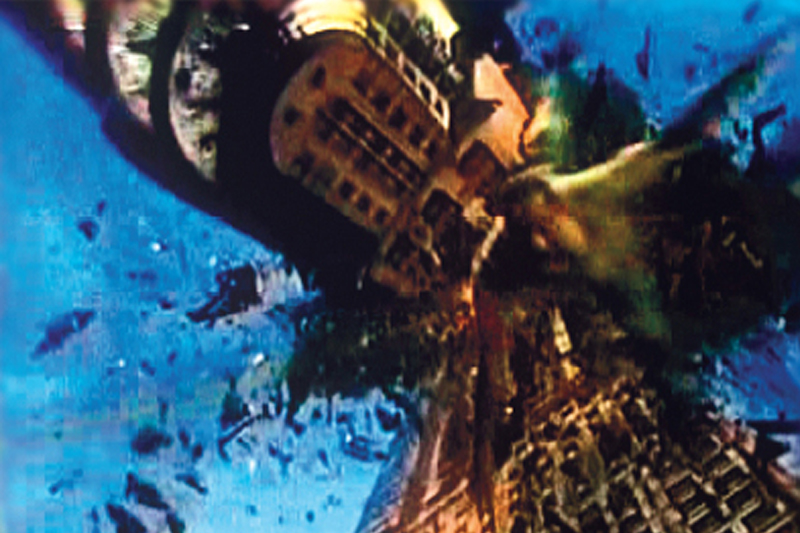
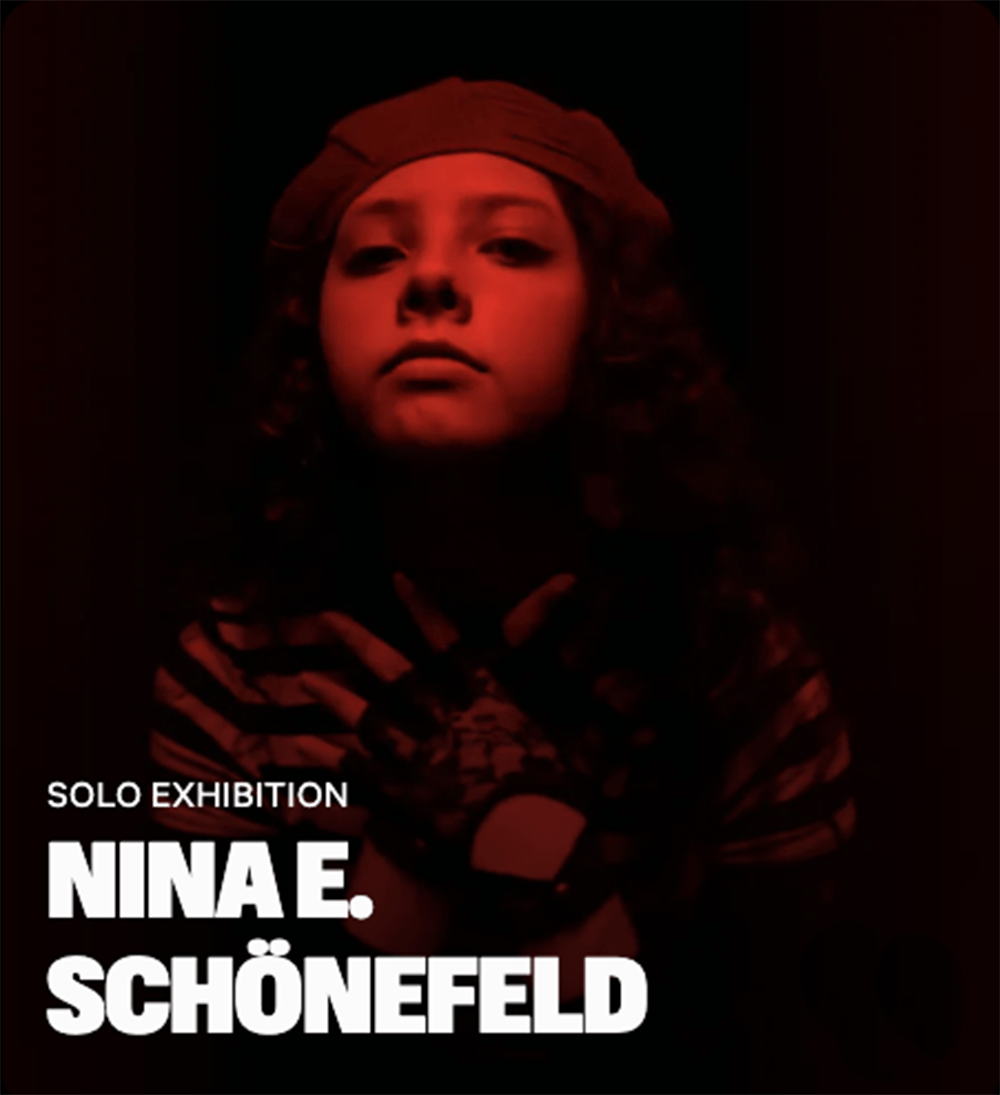
NINA E. SCHÖNEFELD:
ART IS MY REVENGE
Streaming from 4 November 2025 on CIFRA
Sign up now to watch the full program here
and explore the artist’s page of CIFRA here
CURATORIAL STATEMENT
In this solo exhibition, German artist Nina E. Schönefeld takes you on a cinematic journey through fear, hope, and resistance. Across a series of short films, you move through illusions, media noise, and digital decay—a world disturbingly close to our own. You can watch it in one continuous flow or pause between films to reflect; each piece opens a new chapter in the same unfolding story.
What if catastrophe isn’t a single moment, but the world we already inhabit?
We live in a world where the feeling of an impending doom has become the norm. What was once described as “the oblivion of being” and “the end of man” is now an everyday experience. Modernity exists in a state of “collapse”: everything is accelerating, compressing, and losing depth. We can no longer distinguish between the real and the imaginary, and this catastrophic illusion—something Baudrillard wrote about—has become our natural environment. It is not an apocalypse, but a slow dissolution where fear, fatigue, and anxiety are not just reactions; they are the background against which we live.
This is the state in which Nina E. Schönefeld works. Schönefeld uses the alienation of post-apocalyptic cinema aesthetics to tell site-specific, fictional stories and reveal their effects. Her films do not merely record events; they capture the tension of the present: decadence, loss of orientation, and the suspension between action and powerlessness. Schönefeld tries to revive radical resistance as a response to our increasingly disillusioned times. Through a specific visual language, the work focuses on a spirit of rebellion and a longing for change.
She does not depict catastrophe itself but shows how we coexist with it. Her horror does not stem from monsters but from a weary norm where everything terrible has already happened, and we have simply become accustomed to it. Her focus is on hyperobjects—phenomena that cannot be perceived in their entirety but that influence everything around them. Themes such as digital illusion, media manipulation, viruses, nuclear waste, and oceans full of plastic recur in her films like haunting dreams, merging the personal and the political. These narratives are not separate but parts of a larger body that breathe anxiety and hope at the same time.
In an impressively short span—around fifteen years—Nina E. Schönefeld has created an entire world. Her films, shown at a solo exhibition at KINDL – Zentrum für Zeitgenössische Kunst (2024/25, curated by Katrin Becker) and included in Rachel Rits-Volloch’s program for CIFRA The Body: Any Body Knows, construct a distinct universe that is disturbing, precise, and deeply human. Given the quantity and scale of her work, this timeframe seems incredibly condensed, almost timeless.
Schönefeld employs multiple media—video, sculpture, painting, and text—all of which are integral parts of a single expression, a unified intonation. Behind this multitude of forms lies a rare integrity: clarity of vision, inner discipline, and an almost quiet humanity that resonates in everything she does.
Nina E. Schönefeld’s aesthetic is characterized by its presence, conveying an almost physical fear that lingers long after viewing, remaining under the skin. The demonic images in her films are not external forces but shadows of our time. The artist engages with these images as if they were mirrors reflecting not monsters but our own selves. This is why her films are so poignant—they do not frighten; instead, they remind us: It is never too late to take up the fight. There is always light at the end of the tunnel.
The exhibition progresses from illusion to action, beginning with P.A.R.A.D.I.S.E. (2023). Here, virtual images and social networks create a deceptive sense of peace, where control masquerades as pleasure. Nina E. Schönefeld shows how people willingly choose to live in this controlled illusion, where truth loses its meaning and simulation feels more real than life.
In B.T.R. / BORN TO RUN (2020), the focus shifts to journalists—individuals who are meant to convey the truth but find themselves ensnared by the very system they seek to expose. Their race becomes a means of survival without sacrificing their voice in a world where words can be perilously costly.
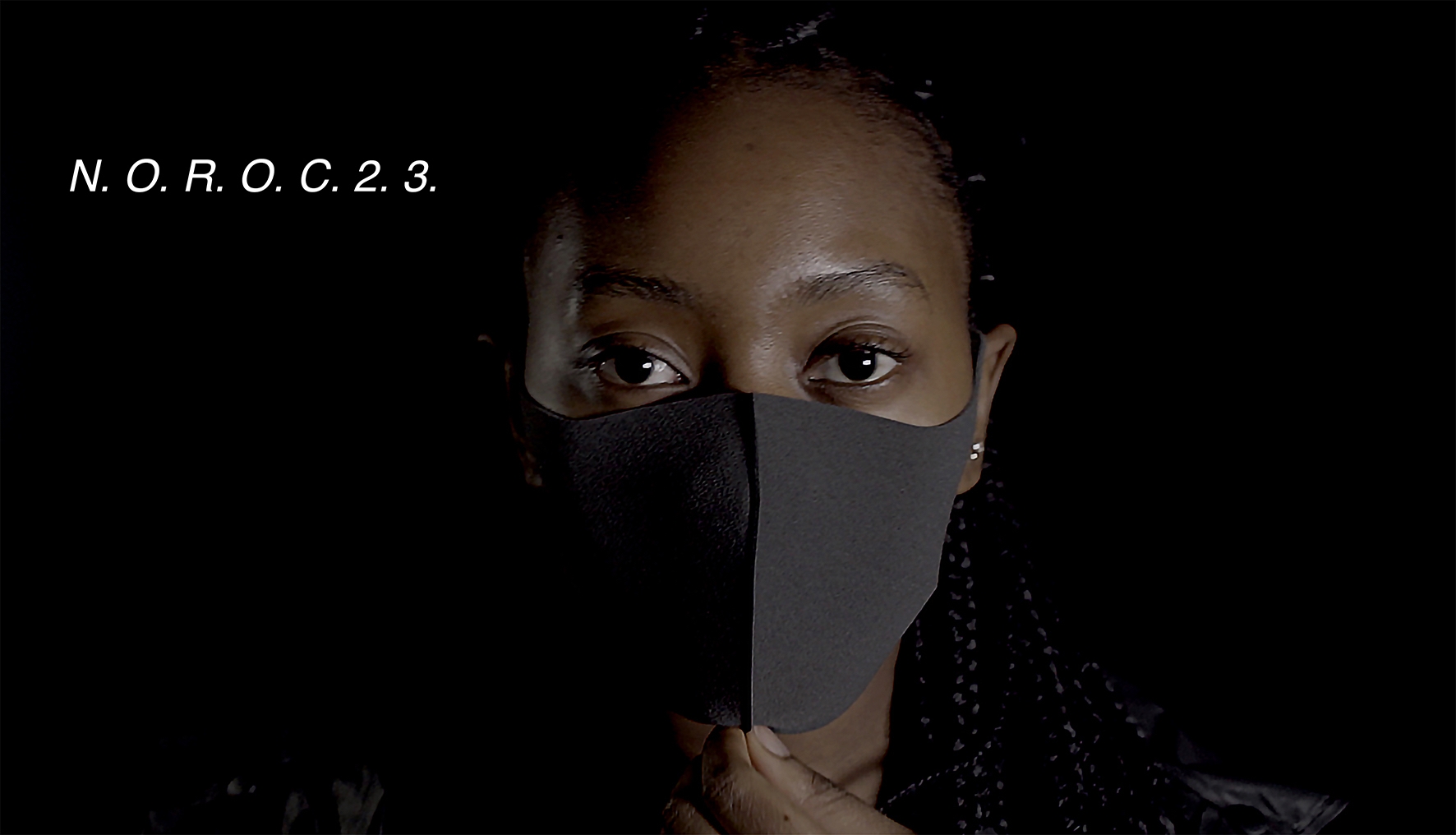
N.O.R.O.C. 2.3. (2020) serves as a moment of pause. The pandemic transforms time into a period of waiting and space into isolation. Familiarity vanishes, leaving only breath, fear, and the struggle to find meaning.
Then comes C.O.N.T.A.M.I.N.A.T.I.O.N. (2021) and D.A.R.K. W.A.T.E.R.S. (2018), which address ecological catastrophes that silently underlie our existence unless we take the time to acknowledge the world around us. Radioactive waters and plastic-filled oceans are not mere metaphors; they represent a stark new reality. Nature is no longer just a backdrop but a mirror reflecting humanity’s impending extinction.
At this moment, we, the audience, face a simple yet profound question: WHY DO WE KILL (2022)? There is minimal action here—only a pause that invites reflection on how easily violence becomes normalized and empathy grows rare.
But after the silence comes movement. R I D E O R D I E (2024) is a film about resistance and solidarity, about the human choice not to give up even when everything is crumbling. There are no heroes here, only determination. The finale of A.R.T. I.S. M.Y. R.E.V.E.N.G.E. (2020) serves as the artist’s personal manifest —brief, precise, and almost whispered. Art is not a consolation or salvation but a form of action—the last vestige when all other forms of communication fail.
It is no coincidence that each of Nina E. Schönefeld’s films begins with a road, a landscape, or a view into the distance. The viewer is invited to embark on a journey, to choose their path in the (un)real world, and to confront their catastrophe and focus on the moment of decision when relentless, radical rebellion begins.
ABOUT THE ARTIST
Nina E. Schönefeld (born in Berlin) is a multimedia video artist with German-Polish roots. She studied at the Berlin University of the Arts and the Royal College of Art in London. Her works have been shown at KINDL – Centre for Contemporary Art, Lothringer 13 Kunsthalle, Münchner Kammerspiele, Kunsthalle Osnabrück, Berlinische Galerie, Heidelberger Kunstverein, Haus am Lützowplatz and among other international institutions at Tokyo Roppongi Art Festival, Goethe Institute Beijing, MSU Museum Michigan, Kunsthalle Bratislava, FED Square Melbourne, Aleš South Bohemian Art Museum, Aram Art Museum Korea. Nina E. Schönefeld lives and works in Berlin.
Nina E. Schönefeld creates future scenarios that are closely linked to current political, ecological and social issues. Recurring themes in her works are the global upsurge of autocracies and populism, the threat to press freedom, climate change and the supremacy of large corporations in capitalist systems. She operates with an installation method of different light & sound systems, electronic machines, sculptures, costumes, interiors, and video screenings.
CIFRA is a platform and global community for experiencing and streaming contemporary art — from video and sound to dance films, glitch art, game art, and beyond. Featuring curated selections by leading international curators, CIFRA offers thematic playlists and editorial programs that guide viewers through the most relevant and thought-provoking works of today. Right now, new artists are joining every week, new playlists are going live, and viewers across 113 countries are discovering powerful works in over 75 genres. CIFRA’s growing archive includes 2,780+ artworks by 1,299 artists — and a global community of over 15,000 art lovers is already here. Tune in, explore, and be part of what’s shaping the future of art — live on CIFRA.
WORKS IN THE EXHIBITION
P. A. R. A. D. I. S. E.
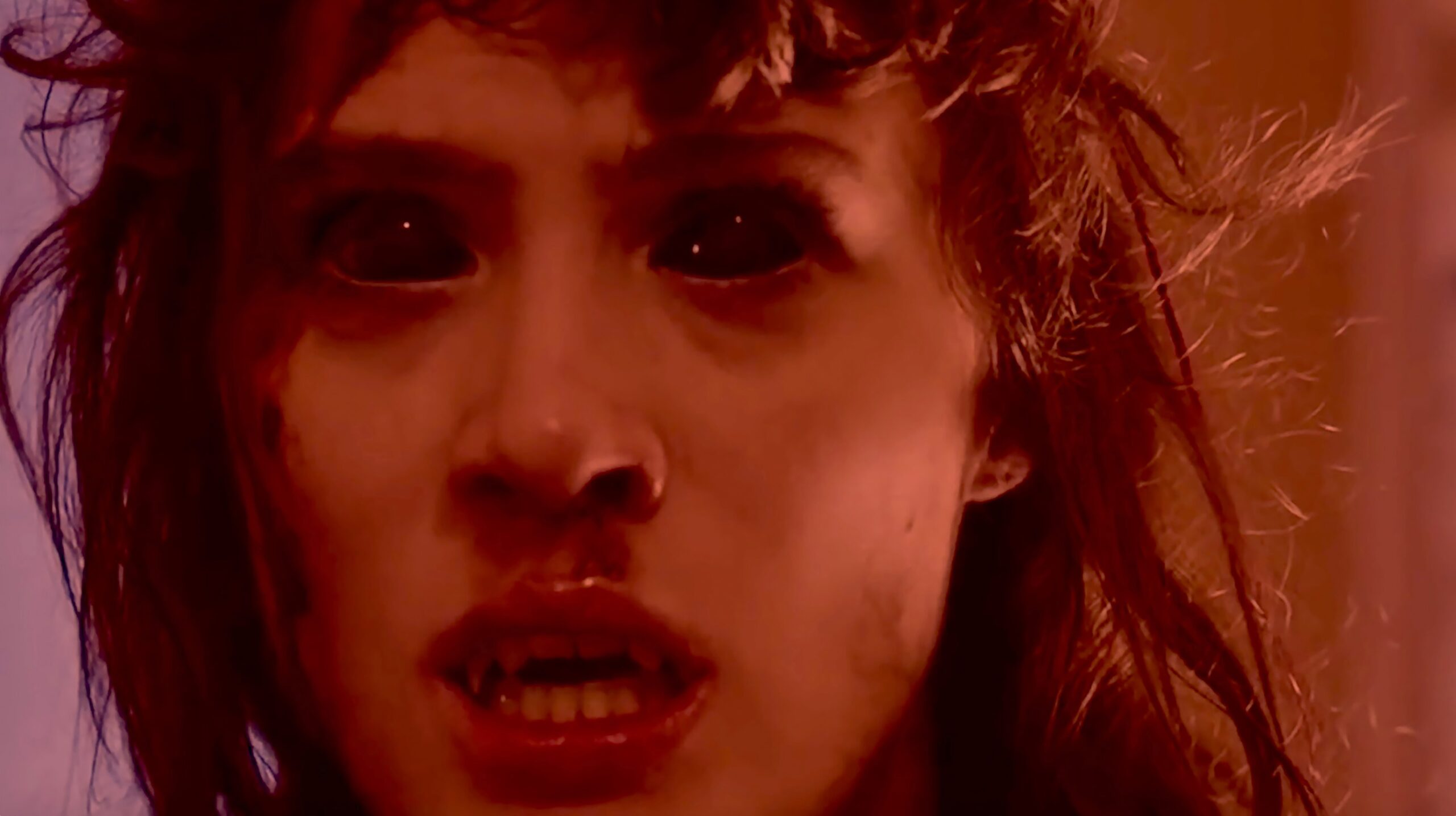
P. A. R. A. D. I. S. E. deals with a new VR program to create ultimate feelings. People test their limits. The game causes insomnia and sometimes sudden death. “The feeling of love is ridiculous compared to the feeling of nearly dying. I am scared of wanting more.” The video work shows the difference between the experience of virtual reality in artificial space and the experience of physically tangible reality in nature. The investment of global corporations in digital technology and virtual reality is to extend the appropriation of human life to every aspect of our existence in order to maintain control over markets and indirectly also over us. We are spending longer and longer in virtual worlds and are becoming more and more dependent. Even though reality often seems surreal today and virtual reality appears more real, there is still a difference. It is a question of truth.
2023, HD video, 27 min 23 sec, color, 1920 × 1080, with sound
Written, edited & directed by Nina E. Schönefeld
Director of photography Valentin Giebel
Sound & music Carlos Pablo Villamizar
Special thanks to DJ Hell
Starring Ana Dossantos / Änni Lee Jones / Thinley Wingen / Sophia Arndt / Keschia Zimbinga / Katja Turella / Chantal Hountondji / Talia Bakkal / Acelya Bellican / Karla Sophia Menzel / Jessica Daxenberger / Falko Nickel
B. T. R. (BORN TO RUN)
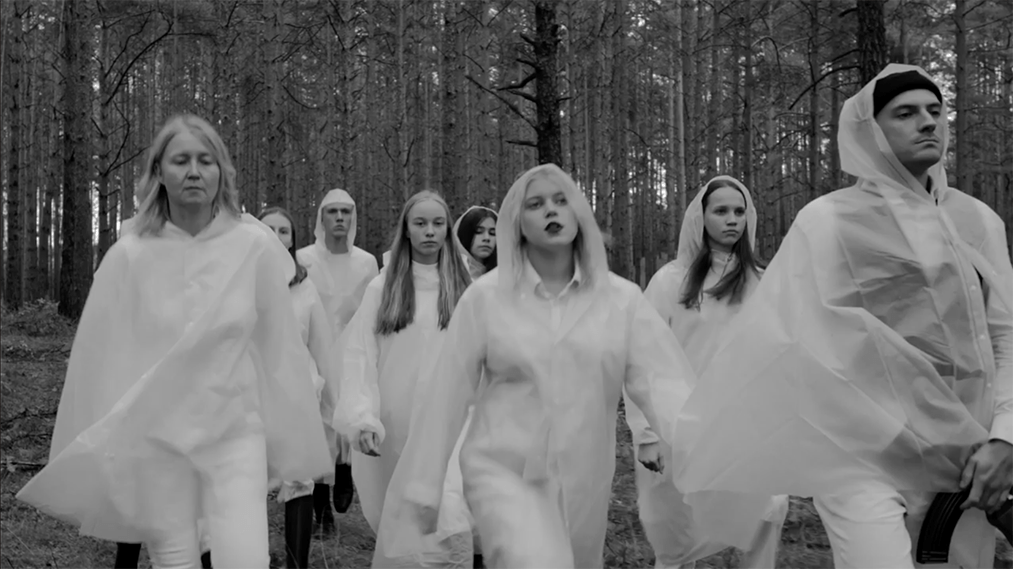
B. T. R. (BORN TO RUN) is set in the year 2043 and revolves around the increasing strength of authoritarian autocracies, the restriction of journalists and freedom of speech. Authoritarian media corpo-rations control world events; escape from total control seems almost impossible. Children and young people are trained in training camps to become killing machines. But at a certain point in the drill, the young protagonist S.K.Y. releases defense mechanisms. She drops out. Her research into her own identity, stolen by the state, leads her step by step to active resistance. The artistic adaption is based on detailed research (e.g. on Julian Assange & Edward Snowden, Cambridge Analytica, investigative journalism and far-right movements). Quotes from the film such as “Think of the press as a big keyboard for the government to play on” come from politicians and leaders of the Third Reich – in this case Joseph Goebbels. Statements of this kind can also be found in the speeches of right- wing parties around the world today. Such right-wing strategies of instrumentalization can increasingly be found in the speeches of right-wing parties around the world today..
2020, HD video, 20 min 3 sec, black and white & color, 1920 × 1080, with sound
Written, edited & directed by Nina E. Schönefeld
Director of photography Valentin Giebel
Sound & music Carlos Pablo Villamizar — special thanks to DJ Hell
Starring Anastasia Keren / Thinley Wingen / Alexander Skorobogatov / Lucie Schönefeld / Oda Langner / Emil von Gwinner / Keschia Zimbinga / Ana Dossantos / Chantal Hountondji / Nasra Mohamad Mut / Yuko Tanaka Betts / Falko Nickel / Johanna Langner / Anna Esdal / Stella Junghanss / Nina Philipp / Mike Betts / Christopher Schönefeld / Joanna Buchowska / Alexander Sudin / Andreas Templin / Dirk Lehr / Ginger Fikus / Talia Bakkal / Acelya Bellican / Marlah Lewis / Amira Yasmin / Josephine Lang / Leo Burkhardt / Lisa Nasner / Violetta Weyer / Marina Wilde / Timothy Long / Sean Jackson / Riley Warren / Katja Turella & Hansa Wisskirchen
N. O. R. O. C. 2. 3.
Under the title N. O. R. O. C. 2. 3. life during a worldwide pandemic crisis is transported through gloomy dark images. It is about the feeling of constant insecurity and a panicky, invisible threat. The video is based on portraits of four independent women and a large pool of research materials. Historical quotations, passages from novels, series and films, political speeches, stock footage, video portraits and media reports from different periods of our history are put together in a kind of narrative video collage to create a “psychogram” of the time during a pandemic. This narrative is accompanied by intense scenes, all of which take place at night. In the centre: four female protagonists roaming through empty cities whose silence conveys a deceptive feeling. Looking for a way out, they do not know what the next day will bring. The optimistic conclusion at the end: Out of stagnation grows something new.
2020, HD video, 8min. 23sec., color, 1920 x 1080, with sound
Written, edited & directed by: Nina E. Schönefeld
Director of photography: Valentin Giebel
Starring: Ana Dossantos / Chantal Hountondji / Nasra Mohamad Mut / Keschia Zimbinga
C.O.N.T.A.M.I.N.A.T.I.O.N.
“This is RESIST CLIMATE CHANGE.
We do not forgive.
We do not forget.
Expect us to never stop fighting.”
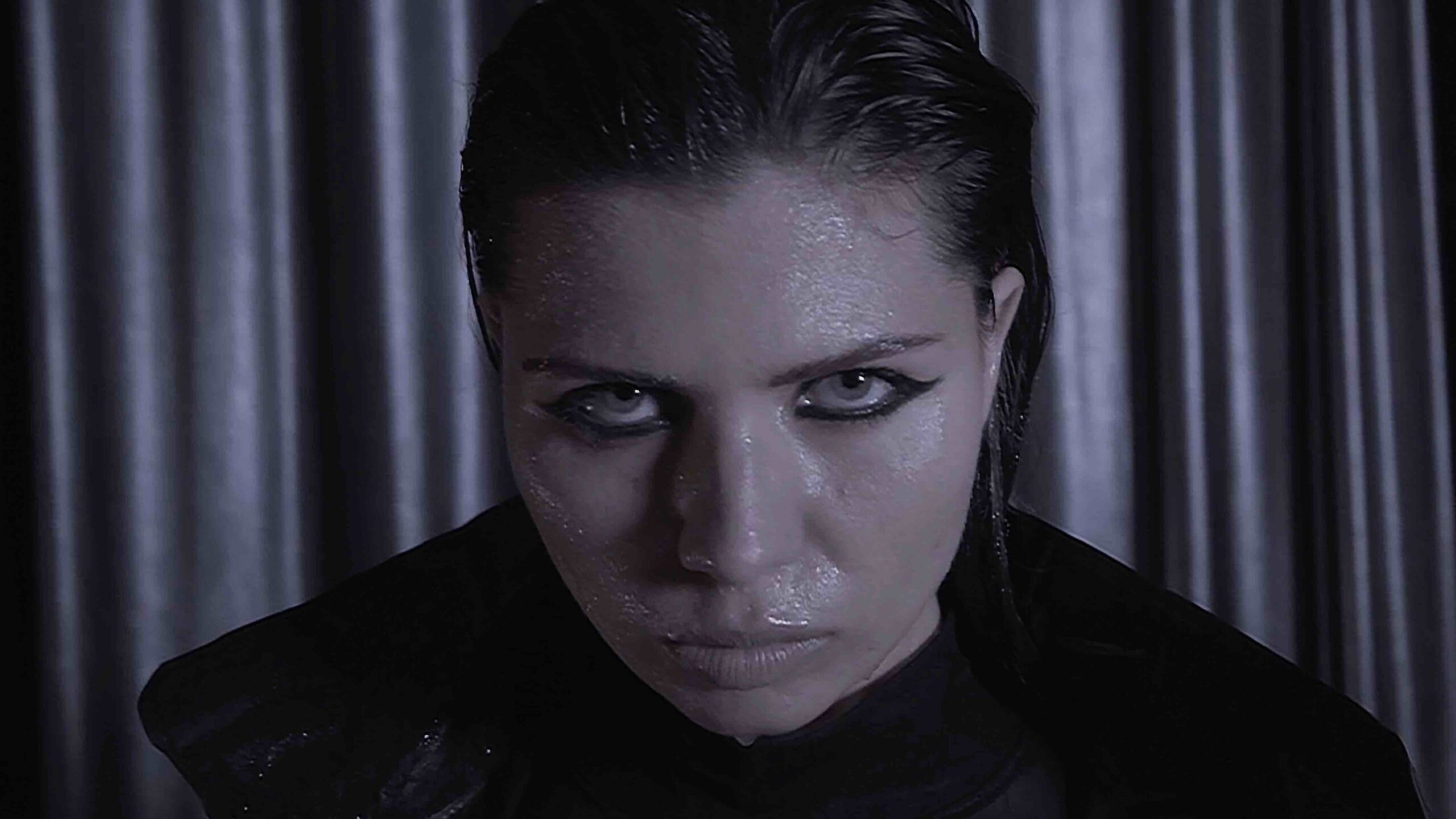
Since the late 1970ies Greenpeace has been fighting against dumping of nuclear waste in the seas to prevent worldwide contamination. 2019 Extinction Rebellion and Fridays for Future were omnipresent. Since Covid everything has changed, and the environmental threat of climate change has intensified.
2030 is fast approaching and will be a crucial year for the world.
2021, HD video, with sound, 11:11 min.
Written, edited & directed by Nina E. Schönefeld
Director of photography: Valentin Giebel
Sound & music: Carlos Pablo Villamizar
Starring: Sophia Salebia & Daria Prydybailo
DARK WATERS
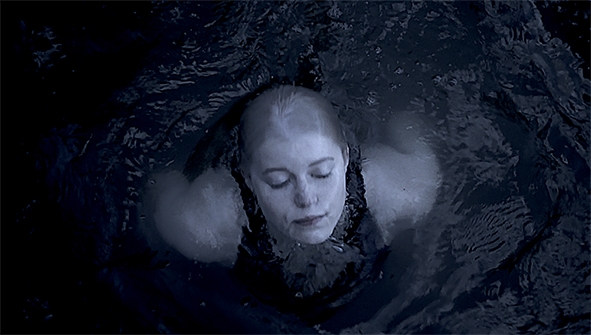
DARK WATERS is set in the year 2029. All the oceans are contaminated with plastic waste that they have become death zones. The only creatures still able to live there are poisonous jellyfish. Everyone is trying to keep this eco-disaster a secret. The film narrates the risky quest for the truth by helicopter pilot Silver Ocean trying to find her little sister Stormy.
2018, HD video, 15min. 55sec., black and white & color, 1920 x 1080, with sound
Written, edited & directed by Nina E. Schönefeld
Director of photography: Valentin Giebel
Sound & music: Carlos Pablo Villamizar
Starring: Thinley Wingen / Mimi Taylor / Leonie Heuermann / Katja Turella / Aleyna Capar / Jacob Haas / Robert Medicus / Jeremy Schilf / Zev Tuguldur / Larry Zimbinga
W H Y D O W E K I L L
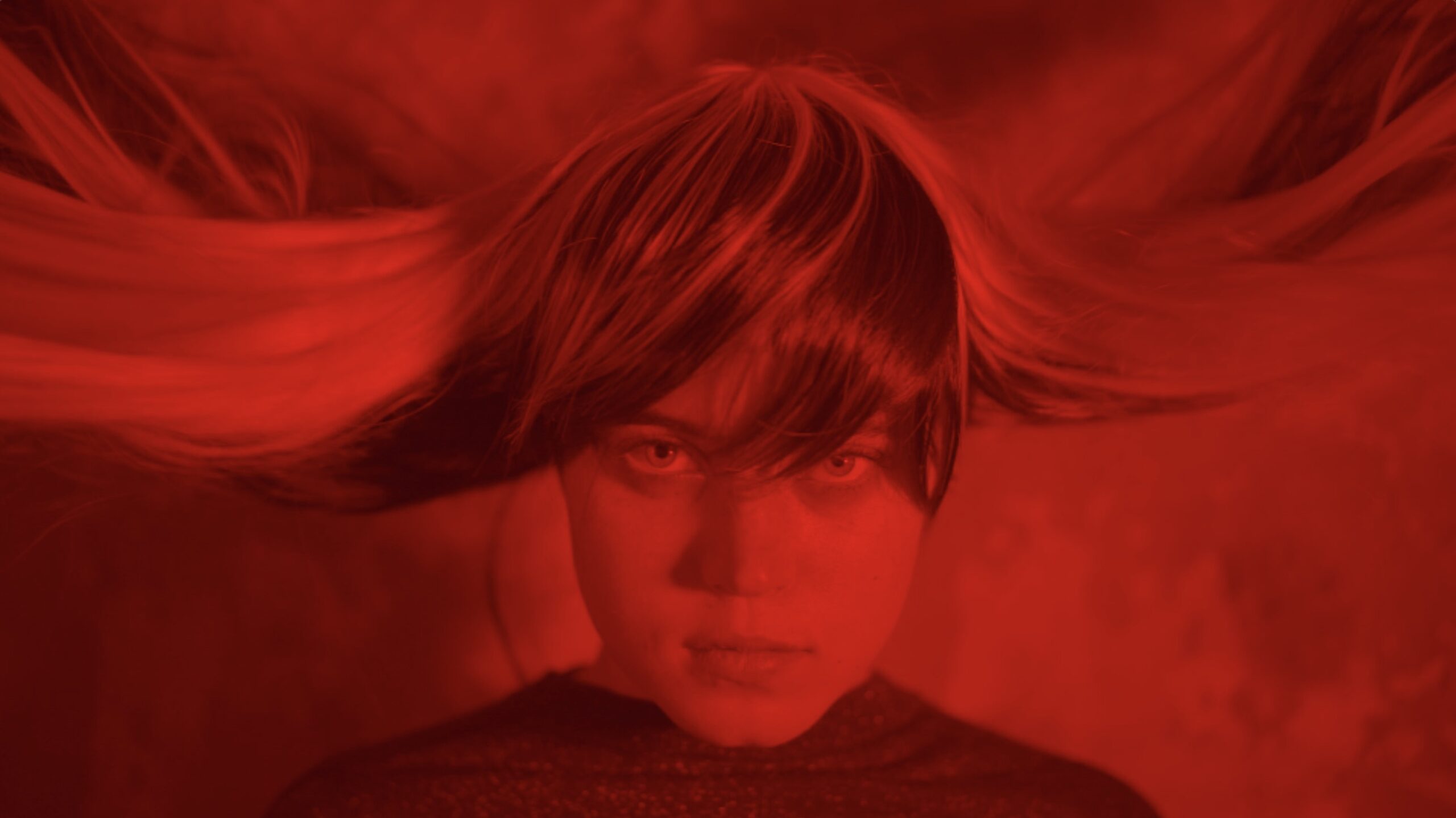
W H Y D O W E K I L L is a video project that is a direct reaction to the situation we are facing in times of war. It is about the feeling of constant insecurity and a panicky, invisible threat. Images of a dancer and various quotes from different sources on the subject of violence are condensed into a kind of collage to create a feeling of our worst nightmares.
Violence is the use of force to injure, abuse, damage, or destroy. It is “the intentional use of physical force or power, threatened or actual, against oneself, another person, or against a group or community, which either results in or has a high likelihood of resulting in injury, death, psychological harm, maldevelopment, or deprivation.” Alternatively, violence can primarily be classified as either instrumental or reactive and hostile.
The complex theme of violence is connected to a systemic problem of the world. The principle of constant economic growth, combined with globalization, is creating a scenario where we could see a systemic collapse of our planet’s natural resources. Capitalism is inherently exploitative, alienating, unstable, unsustainable, and inefficient and it creates massive economic inequality, commodifies people, degrades the environment, is anti-democratic, and leads to an erosion of human rights because of its incentivization of imperialist expansion and war. W H Y D O W E K I L L ?
2022, multichannel HD video, 07:01, black and white & color, with sound
Written, edited & directed by Nina E. Schönefeld
Director of photography: Valentin Giebel
Starring: Thinley Wingen
R I D E O R D I E
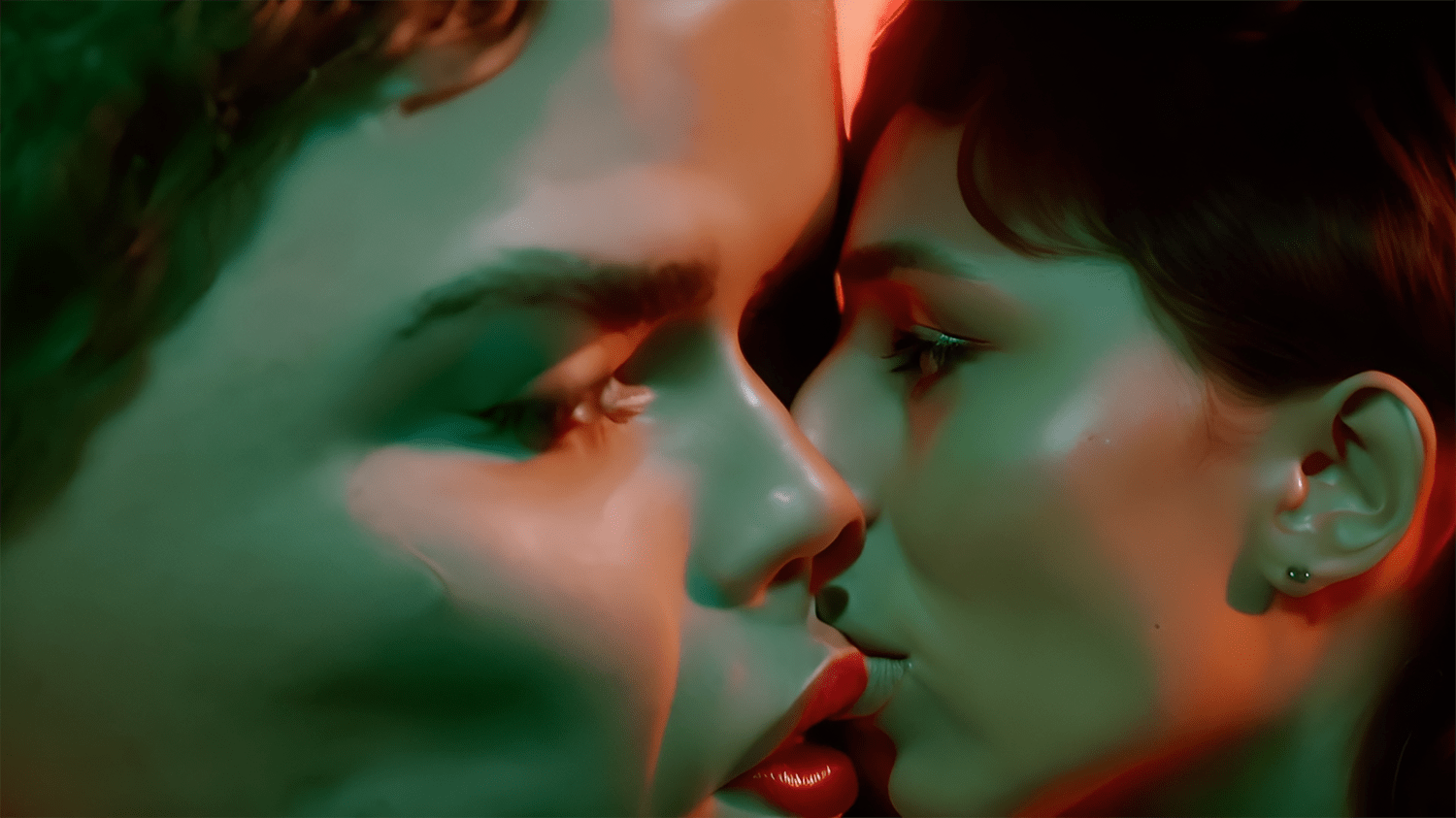
R I D E O R D I E is a video installation that calls for relentless, radical resistance and discourse in response to our increasingly disillusioned times. It is about a crucial question of principle in the private and political life of every citizen. Ride or die?
The story of the video work revolves around a young couple who must experience the political upheaval in their country from a democracy to a right-wing populist autocracy. In the young couple’s reality, total surveillance by CCTV has become normal. They keep asking themselves how a political upheaval and the abolition of the separation of powers could have happened in their home country in the first place.
This video work is about the slow processes of change that are taking place almost silently in society and politics, and which are supported above all by an educated, almost fearful elite. The film’s capitalist future society is characterized by a lack of transparency, the soft simplification of political discourse, fear through surveillance and the distraction from debates on justice, providing a fertile breeding ground for populist autocrats in the increasingly complex political arena.
The young lovers quickly reach the point where they have to decide whether or not to go underground, which is dangerous for their lives. Based on a personal love story, it deals with aspects such as unconditional radical resistance, solidarity at all costs, justice and absolute love, right up to the possibility of death together.
2024, HD video, 30:13, black and white & color, with sound
Written, edited & directed by Nina E. Schönefeld
Director of photography: Valentin Giebel
Sound & music: Carlos Pablo Villamizar
Starring: Maria Ivanova / Robert Gründler / Caroline Shepard / Benjamin Haim Shepard / Lea Carrera / Lilian Schulz / Jessica Daxenberger / Manfred Peckl / Violet Green / Sophia Salebia / Emilio Rapanà / Max Holle / Dorothy Shepard / Änni Lee Jones / Barrett Shepard
ART IS MY REVENGE
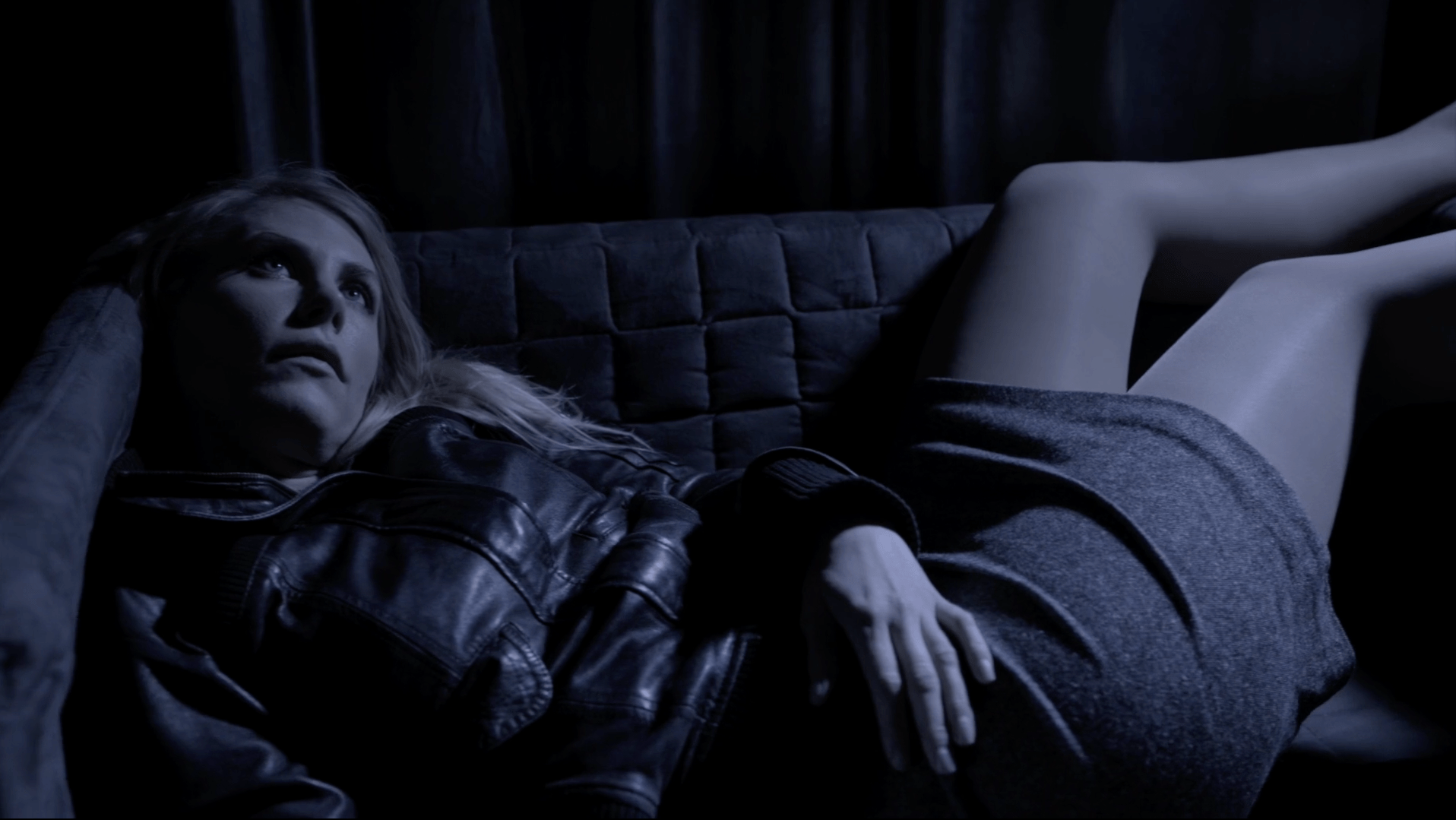
When one encounters the term “Revenge” or “Vengeance,” it is with excitement, suspicion and dread. For vengeance to exist, there must be a prior perception of victimhood, a grievance. The scale of which is determined by the protagonist, but the roles can quickly be flipped. And flipped and flipped again. The chain of vengeance can go on and on and, unless broken, lead to ever escalating levels of calamity.
2019, HD video, 3:49 min, black and white & color, 1920 x 1080, with sound
Written, edited & directed by Nina E. Schönefeld
Director of photography: Valentin Giebel
Starring: Charlie Stein / Andy Best / Anna Kolod / Thinley Wingen / Leonie Heuermann / Katja Turella