

 Back to Index
 |
|
MARGRET EICHER
(b. 1955 in Viersen, Germany. Lives and works in Berlin, Germany.)
Margret Eicher works primarily with intricate digital collages produced as large format tapestries woven on a digital loom. Invoking the traditional use of the tapestry as a tool of wealth and power, and commenting on our increasing reliance on digital culture, Eicher fills her tapestries with contemporary icons from our overly mediated age alongside quotations from art history.
“With her media tapestries, Margret Eicher refers directly to the function and effect of the historical tapestry of the 17th century. Since the Middle Ages, tapestries have served representative and political purposes like hardly any other visual medium. In the Baroque era, however, the courtly tapestry unfolded and optimized its functions in the representation of power, in ideological communication and propaganda. If one compares functions of the baroque communication medium with those of contemporary mass media, astonishing parallels emerge. Manipulation of the viewer and philosophical reflection on life stand side by side in a value-neutral manner. Although in the courtly context the propagandistic dispersion and thus the circle of addressees is limited, the intention, method, and effect are structurally similar. In choosing her subjects, Margret Eicher draws from the public image fund of advertising and journalism; of lifestyle magazines or TV series. Combined with set pieces from historical paintings by artists such as Albrecht Dürer, Hans Holbein, Antoine Watteau, or Thomas Gainsborough that correlate in terms of content, they are elaborately digitally processed and finally woven with the aid of computers. By being transformed into a monumental tapestry, the content of the image gains the appearance of legitimacy and power, then as now. The hegemony of advertising media and contemporary information media with their tendencies towards scandalization find a counterpart in this. “Whatever images and visual worlds Eicher appropriates, she relies on one of the basic properties of tapestry to give her pictorial themes a mouthpiece and lend them weight. The tapestry, even if the medium itself is instrumentalized, finds its way back to its original function as a means of communication in the artist’s works and, as a subtle quotation, questions the power of images in today’s world.”
– Katja Schmitz-von Ledebur, Secular Treasury KHM Vienna
Solo exhibitions include: Fotogalerie Wien, Vienna, Austria (2000); Wilhelm-Hack-Museum Ludwigshafen, KunstHaus Dresden, Germany (2000); Museum für Angewandte Kunst, Frankfurt, Germany (2001); Galerie Monika Beck, Homburg, Germany (2002); Galerie Ulrike Buschlinger, Wiesbaden, Germany (2003); Forum Ludwig für Internationale Kunst, Aachen, Germany (2004); Rottweil Forum Kunst, Rottweil, Germany (2005); Galerie Bernhard Knaus Fine Art, Frankfurt,Germany (2006); DAM, Stadtgalerie Saarbrücken, Berlin, Germany (2006); Kunstverein Mannheim, Museum Liner, Appenzell, Switzerland (2007); Hamburg Galerie Caesar&Koba, Hamburg, Germany (2009); Stade, Schloß Agathenburg, Germany (2010); Erarta-Museum, St. Petersburg, Russian (2011); Goethe-Institut Nancy (F) Strasbourg (F) ARTE /ZKM Karlsruhe, Germany (2011); Hamburg Galerie Carolyn Heinz, Hamburg, Germany (2012); Kunstmuseum Heidenheim, Germany (2012); Badisches Landesmuseum, Karlsruhe, Berlin Orangerie Schloss Charlottenburg, Germany (2013); Anger Museum Erfurt, Kunstmuseum Ahlen, Germany (2014); CACTicino, Bellinzona, Switzerland (2014); Kunsthalle am Hamburger Platz, Berlin, Germany (2015); Gallery Baku, Azerbaijan (2015); Port 25 Mannheim, Germany (2016); Kunstverein Ulm, Germany (2017); Sprengel Museum, Hannover, Germany (2018); Museum Villa Stuck, Munich, Germany (2020); Haus am Lützowplatz, Berlin, Germany (2021); Galerie Michael Janssen, Berlin, Germany (2021); Moritzburg Museum, Hall, Germany (2022-23).
Recent group exhibitions include: Kunsthalle Darmstadt, Germany (2008); Galerie Eugen Lendl, Graz, Austria (2010); Musee des Beaux-Arts de Tournai, Tournai, Belgium (2011); MOCAK, Krakow, Poland (2012); Museum Liner, Appenzell, Switzerland (2012); Rohkunstbau, Berlin/Roskow, Germany (2013); Tichy Foundation, Prague, Czech Republic (2013); MPK, Kaiserslautern, Germany (2014); Museum Kurhaus Kleve, Germany (2014); Gallery of Art Critics Palace Adria, Prague, Czech Republic (2015); KHM, Vienna, Austria (2015); Stresa, Italy (2015); Kaiserslautern, Germany (2016); Museum Liner, Appenzell, Switzerland (2017); Leipzig, Germany (2017); Galerie Deschler, Berlin, Germany (2017); Singen, Kunstmuseum, Germany (2017); ZKM, Karlsruhe, Germany (2017); Kunstverein Pforzheim , Haus am Lützowplatz Berlin, Kunstverein KunstHaus Potsdam, Germany (2018); Kunstverein Tiergarten, Berlin, Germany (2019); Room Berlin, Germany (2019); Stiftung Staatlicher Schlösser und Gärten Berlin-Brandenburg, Germany (2019); Berlin, Germany (2020); MOMENTUM & Kleiner von Wiese, Zionkirche, Berlin, Germany (2021); Staatliche Kunstsammlungen, Schloss Pillnitz Museum, Dresden Germany (2021); ZKM Karlsruhe/ European Culture Capitale Luxembourg (2022); Boghossian Fondation Villa Empain, Brussels, Belgium (2022).
Embarkation to Kythera2 (2023)
Digital montage/Jacquard, 250 x 360 cm
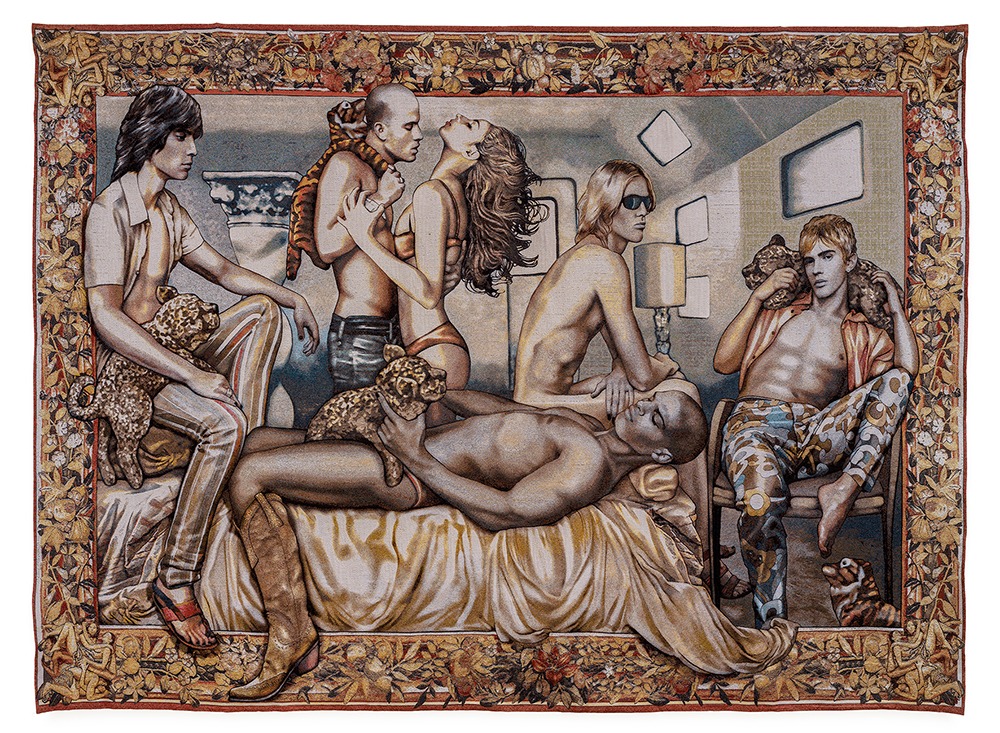
In times of ubiquitous virtual user interfaces, artist Margret Eicher tells her visual stories using the “slow” medium of tapestry, which, from the early 15th century until the Rococo period, was an integral part of feudal aristocratic representative furnishings in the form of gobelins. This medium, which today is only found in museums as a representation of courtly claims to power, is catapulted into the present by Eicher’s repertoire of motifs from a variety of media illustrations, yet always remains linked to the media history of images since the early Renaissance period.
The title alludes to Watteau’s famous painting of the same name from 1717. In this work, which is housed in the Louvre, Watteau depicts the journey of various couples to the Ionian island of Kythera, described in Greek mythology as a place of bliss and the sanctuary of Aphrodite, the goddess of love. In Watteau’s diction, and entirely in keeping with the tradition of peinture des fêtes galantes he established, this painting is imbued with a significantly soft, fairy-tale atmosphere, which makes it clear that the painter’s work was also about creating a dream image and illustrating the power of poetry. The embarkation for Kythera thus appears as a metaphor for the power of imagination, whose suggestion of an idyllic dream landscape is stronger than reality itself. Margret Eicher’s adaptation of the amorous Kythera myth, based on an advertising motif by the fashion company Dolce & Gabbana, turns the lovers—whose happiness lies in a dreamlike, distant image that never has to become reality because all longing is fulfilled in itself—into a self-referential staging of androgynous, perfect bodies.
These fabulous bodies may be together in a room that could also be a salon on an elegant yacht, but their desire is essentially directed solely at themselves. Their strict avoidance of eye contact makes it clear how much the ritualistic lust displayed here is intended not for the other, but for their own stimulation. Framed by a lush, swelling border of plants, in whose four corners intertwined orgiastic bodies illustrate, so to speak, the ornamentation of eternal pornographic lust, Eicher’s Kythera carpet proclaims an icy paralysis.
Watteau deliberately left it unclear whether the embarkation in question was a departure or an arrival on the island of Kythera Venus, thereby reinforcing the suspended character of a dream scene. The travelers in Margret Eicher’s painting, on the other hand, know neither the pleasure of arrival nor the pain of departure, nor the longing that dwells in the in-between.
– Stephan Berg, Kunstmuseum Bonn
Zeus Appears To Eva In The Shape Of A Rocket (2013)
Wallpaper Tapestry, color print on paper, 171 x 240 cm
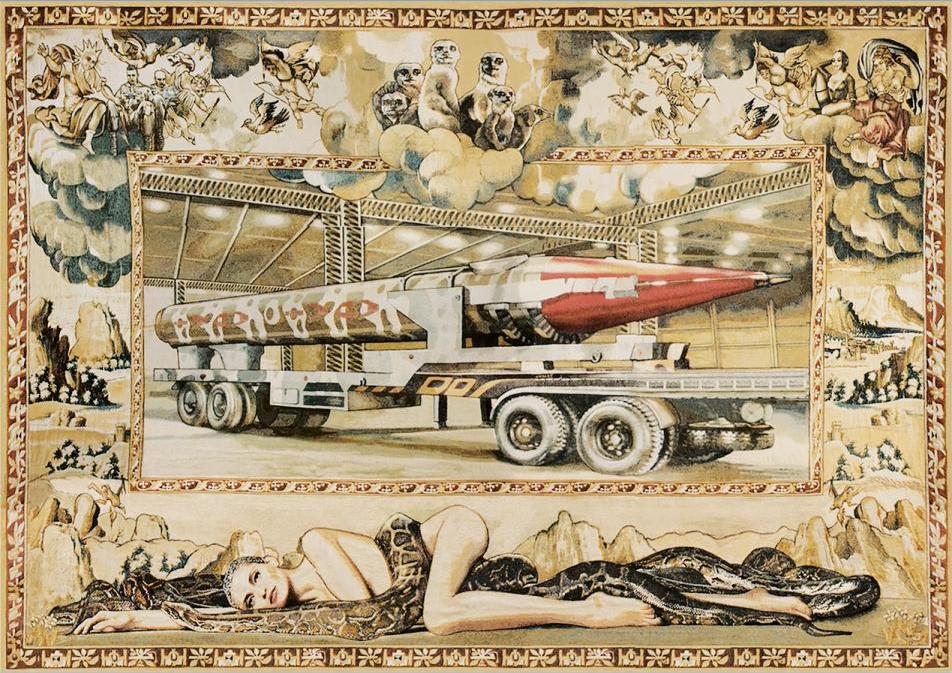
The original tapestry Zeus Appears To Eva In The Shape Of A Rocket (2007), and the wallpaper edition shown in this exhibition, refers to the strongly increasing reliance on images in society. It is no longer text and language that primarily shape political, social and individual attitudes, but ubiquitous images whose truth content is usually no longer verified. Invoking academic research in image theory and visual culture alongside quotations from art history, Margret Eicher’s tapestries are about how we think in images. Zeus Appears To Eva In The Shape Of A Rocket is a digital collage assembled from a press photo of a Chinese long-range rocket mounted on a semitrailer and parked in a hangar, embedded within the frame of a Baroque mythical landscape complete with lemurs perched in the heavens and competing for cloud space with winged cupids, gods and goddesses, Lara Croft and soldiers playing video games. Below, in the plane of the border, a reclining female body is seductively intertwined with a python, whose massive coils keep her modesty intact. It is the star model Linda Evangelista, taken from an image advertising the perfume product of a global corporation. She is Eve, become one with the Christian prototype of seduction, the serpent. While Zeus, the king of the gods, transforms himself into a weapon of war to pay homage to her as the ubiquitous symbol of phallic male aggression. This visual allegory, comingling the recognizable tropes of mythology, religion, popular culture and mass media, addresses the most timeless topics since the dawn of mankind: sex and power.
This work, as are all of Eicher’s digital tapestries, is about our addiction to images and the translatability of visual language across all cultures. Margret Eicher reimagines the historical medium and function of the tapestry for the digital age, down to the production of the works on a digital Jacquard loom. By being transformed into a monumental tapestry, the content of the image gains the appearance of legitimacy and power, then as now. Traditionally serving political purposes, depicting royalty and significant occasions of the times, in the Baroque era especially, the courtly tapestry reached the height of its function in the representation of power and communication of ideologies. Eicher makes striking parallels between the functions and visual language of this Baroque communication medium and those of contemporary mass media today. Depicting the movie stars and media icons which are the equivalent of royalty in today’s content-driven digital culture interwoven with diverse symbols from the history of art and architecture, Eicher’s work looks at how media culture repurposes art history, and questions the power of visual communication in the digital age.
The original tapestry with this motif dates from the year 2007, it measures 235 x 345 cm and is held in a private collection in Trier. Margret Eicher together with Artikel Editions converted the tapestry into a wallpaper edition. The last segment of this nine-part wallpaper is signed by hand. The mural comes in a graphically designed, offset-laminated, numbered and signed graphic tube.
Margret Eicher Catalogues
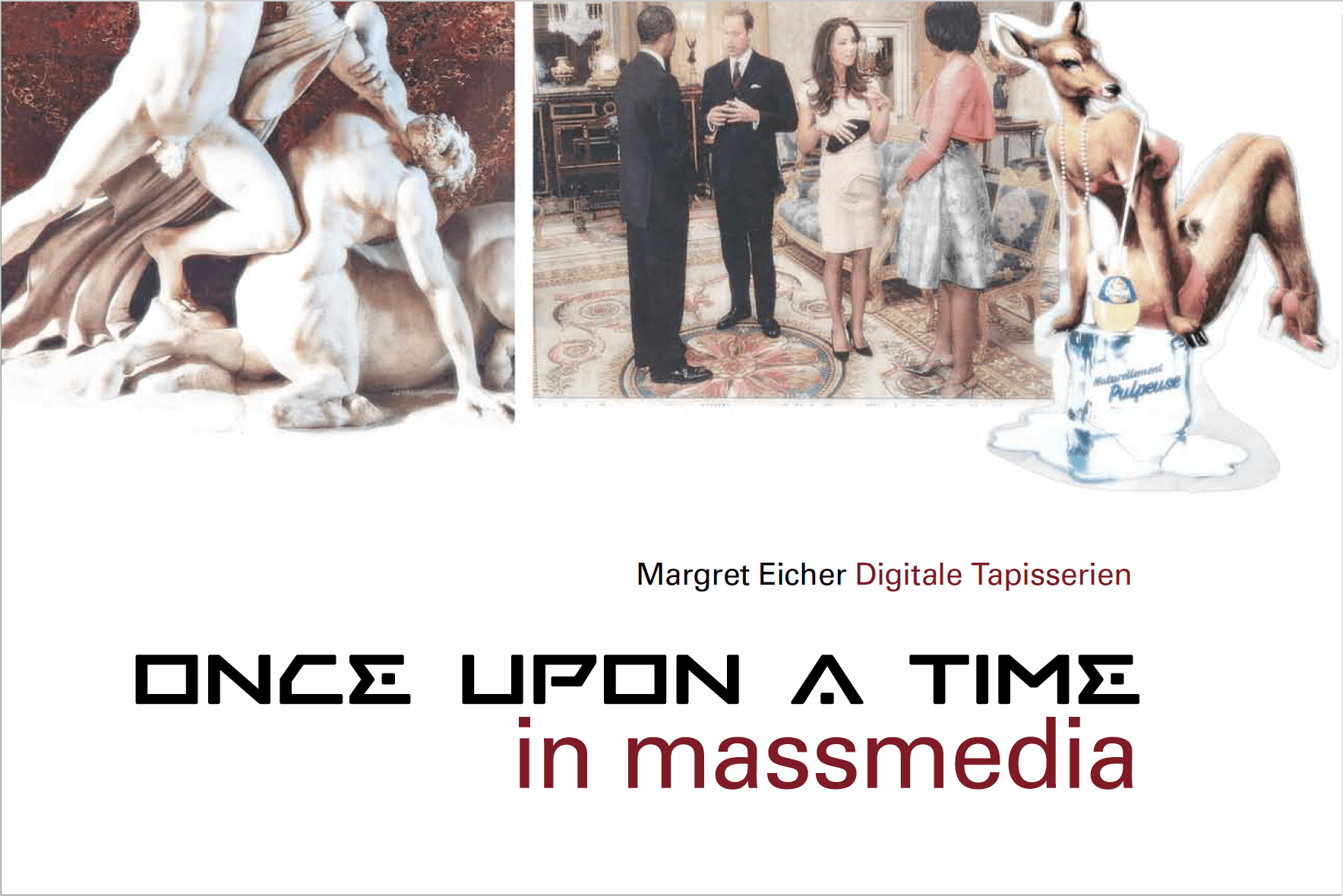


Watch here the Spotlight interview with Margret Eicher